What is WPILib?

The WPI Robotics Library (WPILib) is the standard software library provided for teams to write code for their FRC® or FTC® robots. WPILib contains a set of useful classes and subroutines for interfacing with various parts of the control system (such as sensors, motor controllers, and the driver station), as well as an assortment of other utility functions.

Supported languages
There are three versions of WPILib, one for each of the three officially-supported text-based languages: WPILibJ for Java, and WPILibC for C++, and RobotPy for Python. A considerable effort is made to maintain feature-parity between these languages - library features are not added unless they can be reasonably supported for both Java and C++ (with the C++ able to be wrapped by pybind for Python), and when possible the class and method names are kept identical or highly-similar. Java, C++, and Python were chosen for the officially-supported languages due to their appropriate level-of-abstraction and ubiquity in both industry and high-school computer science classes.
In general, C++ offers better high-end performance, at the cost of increased user effort (memory must be handled manually, and the C++ compiler does not do much to ensure user code will not crash at runtime). Java and Python offer lesser performance, but much greater convenience. Python users should take care to test their program to ensure that typos and other issues don’t cause robot crashes, as Python is interpreted. New/inexperienced users are encouraged to use Java.
Source code and documentation
WPILib is an open-source library - the C++ and Java source code is in the allwpilib mono-repo and python source code is in the mostrobotpy mono-repo. The Java and C++ source code can be found in the WPILibJ and WPILibC source directories:
The Java and C++ source code can be found in the WPILibJ and WPILibC source directories:
While users are strongly encouraged to read the source code to resolve detailed questions about library functionality, more-concise documentation can be found on the official documentation pages for WPILibJ and WPILibC and RobotPy:
Development Timeline
WPILib development happens on branches for individual years, as opposed to one main branch. Development and support for both FRC and FTC happen during different periods to support both FRC and FTC needs. These periods overlap with each other between years, so the following timeline visualizes these overlapping periods to make it easy to understand.
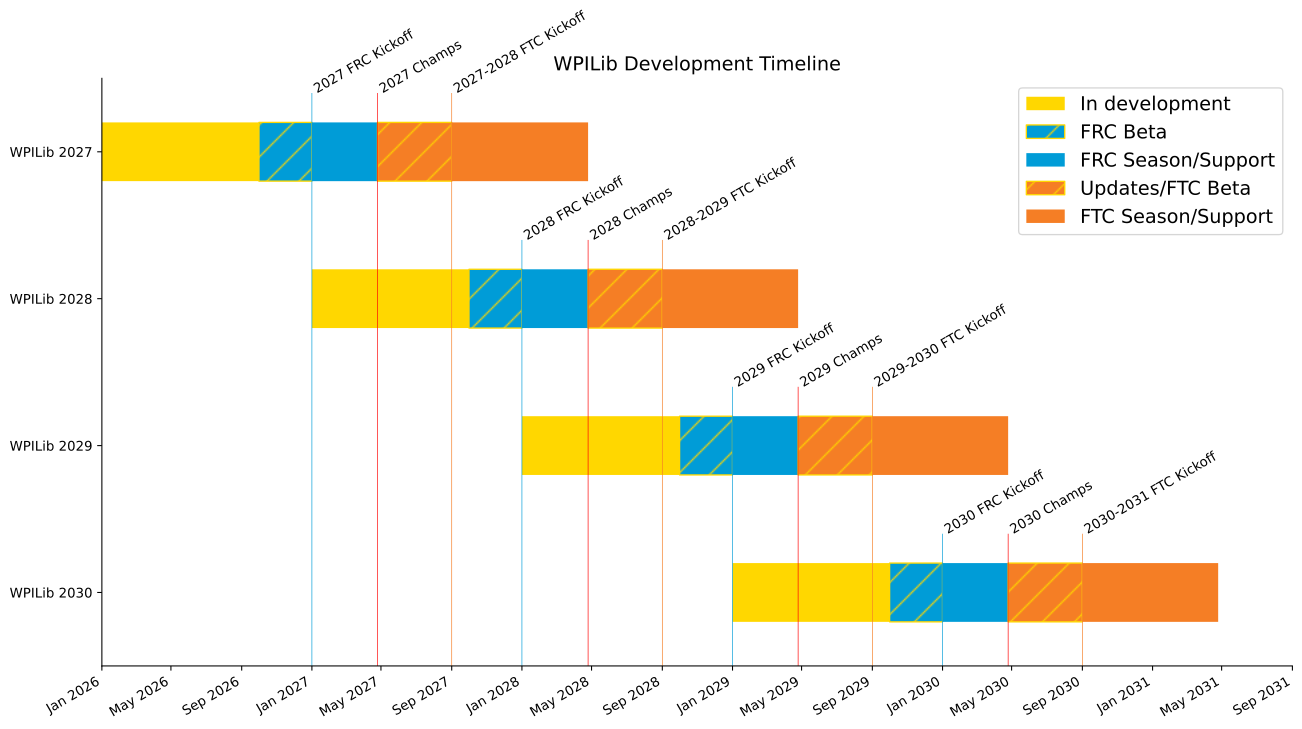
For year N, WPILib will create a branch during year N - 1, and actively do development on it until around October of year N - 1, when it enters the beta testing period for FRC, which continues until FRC Kickoff for year N, which is when the first stable release is published. FRC will receive active support until the FIRST Championship ends, which then begins the FTC beta testing period, which lasts until FTC Kickoff in September of year N. FTC will then receive active support until the next FIRST Championship ends of year N + 1, and then the branch will no longer be supported.
Platform Support
As a broad rule, WPILib only supports OSes that the OS developer still supports. In general, OS requirements are driven by OS developer support and C++ compiler feature support. Per the WPILib roadmap, we want to closely track future evolution of the supported languages, which often means new C++ features are adopted as soon as all supported platforms have compilers that support it. WPILib may continue to build for unsupported platforms, but no official support will be guaranteed, and if newer C++ features are only available in newer OSes, we can choose to adopt them and older OSes with compilers that lack support will no longer be able to build WPILib.
Windows Support
Only 64-bit Windows 11 versions still in support by Microsoft will be supported.
macOS Support
Apple generally keeps the last three macOS versions in support, and releases a new version annually, so WPILib also only supports the last three macOS versions.
Linux Support
For Linux, we follow the Debian release cycle. Debian releases a new version every two years. The version released two summers before a year’s release will become the minimum required OS for that year. This also aligns with Ubuntu LTS releases, so only the last Ubuntu LTS will be supported at a given time.
Minimum required OS versions
OS |
2027 |
2028 |
2029 |
2030 |
2031 |
|---|---|---|---|---|---|
Windows |
11 |
11 |
11 |
11 |
11 |
Debian |
Trixie |
Trixie |
Forky |
Forky |
Duke |
Ubuntu |
26.04 |
26.04 |
28.04 |
28.04 |
30.04 |
macOS |
15 |
26 (Last Intel release) |
27 |
28 |
29 |